Coinoscope: Coin identifier
- 3.7
- Rating
- 1.00M
- Installs
- Free
- Price

 Analysis by App-foxy
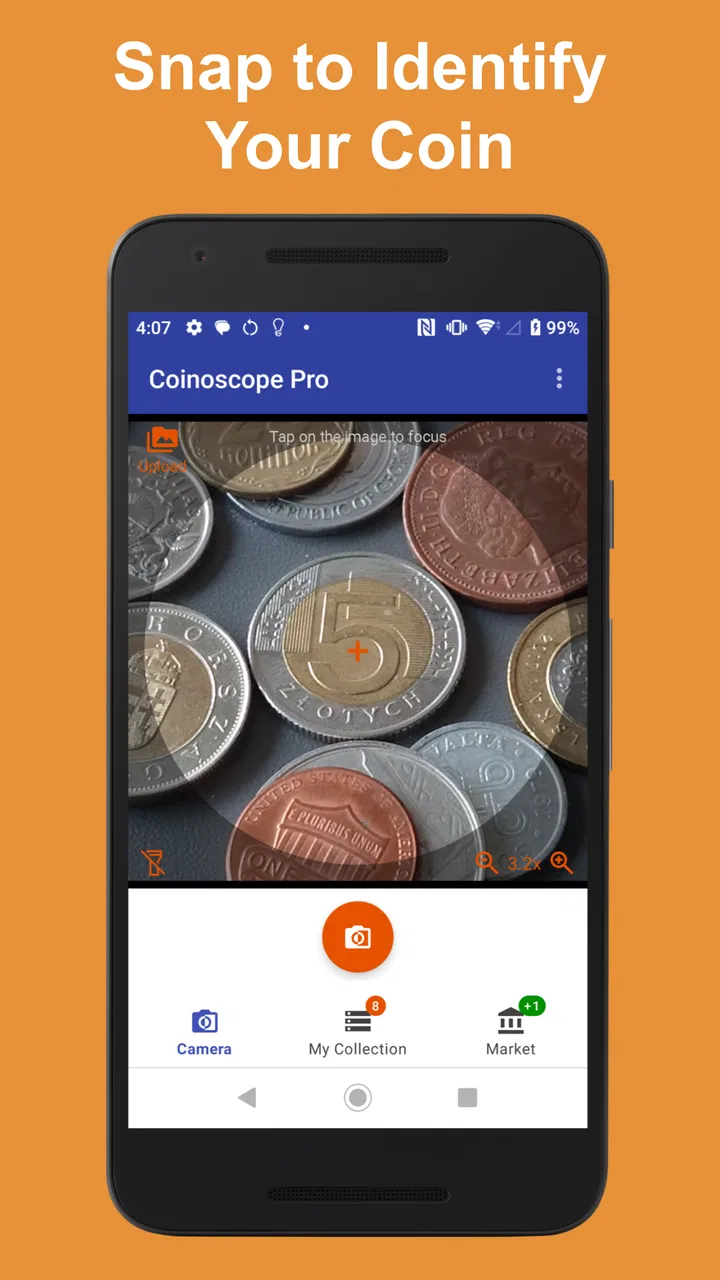
Coin collecting often begins with a simple question: “What is this coin?” Coinoscope turns that question into a camera-based search, letting me point my phone at a coin and look for possible identification and value information. I found it most useful as a first step when I had an unfamiliar coin in my hand, rather than as a final authority for a valuable or historically important piece.
Developed by Miccron, this free Books & Reference app is aimed at casual collectors, travelers, families, and anyone who occasionally finds foreign or old currency. It has an Everyone age rating, works on devices using Android 6.0 or later, and the current version is 4.6.3. The app has passed the one-million-install mark and holds an average rating of 3.7 from around eleven thousand ratings, which suggests a useful but not universally smooth experience.
How the camera search feels in everyday use
The basic workflow is easy to understand. I place the coin where its design is visible, open the camera function, and let the app compare what it sees with likely matches. The appeal is that I do not need to know the country, denomination, or language before beginning. A coin with an unfamiliar portrait or script can still produce a useful starting point.
You May Also Like

 Blood Strike: 2.5 Anniversary
Blood Strike’s Loadouts Turn Every Drop Into a Tactical Gamble
A close look at Blood Strike’s custom loadouts: how fast access to signature weapons reshapes its battle royale rhythm, rewards preparation, and narrows the gap between fights.

 Pandora - Music & Podcasts
Pandora’s Music Is Easy to Start, but Harder to Recover
Pandora’s strength is its low-effort path from a seed to a station. Its weak spot is how much confidence it asks you to place in connection, setup, and quiet recovery.

 8 Ball Pool
 Is Built on Rivalries, Rematches, and Routine
A close look at the rivalries, rematches, shared routines, and unanswered safety questions that turn a quick pool match into a persistent mobile community.

 Samsung Music
’s Quiet Strength Is Playing What You Already Own
Its reach comes less from spectacle than from dependable access to a personal library. That simplicity is both the app’s strongest retention engine and its ceiling.

 AccuWeather: Weather Radar
AccuWeather Review: A Quick, Clear Forecast for Everyday Decisions
For everyday plans, the best forecast is the one you can understand quickly. AccuWeather makes rain timing, radar, and local conditions easy to act on, with a few trade-offs.

 Hill Climb Racing
Why Hill Climb Racing Still Turns Crashes Into One More Run
A tiny car, a bumpy hill and one more upgrade: Hill Climb Racing keeps resurfacing because its simple chaos makes every near-miss feel personal.
More From Our News Desk



That simplicity matters when the coin is part of a mixed group. Imagine emptying a travel wallet and finding several pieces left over from different trips. Searching each one manually would mean identifying the country first, then checking denomination, year, and design. With Coinoscope, I can begin from the image itself and narrow the possibilities more naturally.
In my experience, the camera works best when the coin fills much of the frame without being cropped. A plain background helps separate the edge from the surroundings, while even lighting makes small lettering and relief details easier to recognize. I also prefer taking the coin out of a shiny plastic sleeve before scanning it. Reflections can make a worn surface look more confusing than it really is.
The result should be treated as a shortlist, not a certificate. Similar coins can share portraits, shields, animals, or building designs, and a camera cannot always distinguish a small date or mint mark. I check the suggested match against the coin’s actual lettering, edge, year, shape, and visible condition before accepting it.
Why the network matters at the right moment
The most important connectivity issue appears after the photograph has been taken. Coin identification is not just a local camera effect; the useful part of the process depends on obtaining matching information. In a place with a weak signal, the scan can feel less immediate, and an apparently simple identification may require patience.
This changes how I use it outdoors. At a flea market, an antiques stall, or while traveling, I would not rely on Coinoscope as my only tool if I knew the connection was unreliable. I might still photograph the coin and keep the details in mind, but I would wait until I had a dependable connection before making a buying decision.
That limitation is especially relevant when someone is comparing several coins quickly. A delay between scans interrupts the rhythm: examine, capture, wait, compare, and move on. When the connection is stable, the process feels much more natural. When it is not, the app becomes a reminder that visual recognition and reference information are separate parts of the experience.
I also recommend avoiding rushed conclusions while a result is still loading or when the first suggestion looks plausible. A familiar-looking coin can lead to an incorrect value assumption. The network helps deliver possibilities, but judgment still comes from inspecting the physical object.
Using it on a phone rather than at a desk
Coinoscope makes the most sense on a phone because the object and the camera are already together. I can scan a coin on a kitchen table, in a hotel room, or beside a collection box without setting up a computer. That portability is its strongest advantage over the usual alternative of typing descriptions into a search engine.
Typing “silver coin with a bird and a crown” is slow and often produces broad results. A dedicated camera search gives me a more direct route, particularly when I cannot read the script. It is also less intimidating for a beginner who does not yet know which details matter.
Still, the phone format creates practical compromises. Small coins are easy to move out of focus, and bright overhead lights can produce glare. I get better results by holding the phone steady, rotating the coin instead of waving the phone around, and checking both sides when the first result is uncertain. A second image from the reverse can be more useful than repeatedly photographing the same face.
For a group of coins, I would not scan them all in one rushed session. I sort them by apparent country, size, or design first, then examine the unusual pieces separately. This reduces confusion and makes it easier to notice when two similar coins have different dates or inscriptions.
A practical workflow for mixed coins
My preferred routine has four stages. First, I clean only the loose dust with a soft, dry cloth; I avoid aggressive polishing because surface wear is part of a coin’s identity and potential value. Second, I photograph the clearest side under diffuse light. Third, I compare the suggested identification with the reverse and edge. Finally, I record the likely country, denomination, year, and any unusual mark before moving to the next piece.
This approach reveals one of the app’s less obvious strengths: it helps organize curiosity. Instead of jumping straight to a price, I use the camera result to create a research trail. That is more valuable than a single exciting number, especially when a coin looks old but is actually a common modern issue.
For a parent or teacher, the same workflow can turn a handful of coins into a small geography or history activity. A child can predict the country from the symbols, scan the coin, and then compare the result with the lettering. The Everyone rating makes that kind of shared use comfortable, although an adult should still explain that an estimated value is not the same as a guaranteed selling price.
What happens when a scan is weak or wrong
Recognition is naturally less dependable when the coin is heavily worn, dirty, scratched, unusually shaped, or photographed at an angle. A commemorative design may also resemble several other issues. In those situations, I do not keep repeating an identical shot and hope for a different answer. I change one variable at a time: lighting, distance, background, or side of the coin.
If the result still looks doubtful, I use the visible clues as search terms elsewhere: country name, denomination, year, and a description of the central symbol. This is where a traditional reference book or a specialist catalog can outperform the app. Printed references are slower, but they encourage careful comparison and do not depend on a camera result being visually similar.
Recovery is also easier when I keep the physical coin in view. I compare the suggested image with the actual rim, lettering, portrait direction, and date rather than trusting the thumbnail alone. If the app identifies a coin from the wrong country but the design is similar, that mismatch is useful feedback: it tells me which detail needs closer inspection.
I would be particularly cautious with rare-looking pieces. Coinoscope can help me discover what I may have, but I would not use one camera result to sell a coin, pay a premium, or declare it authentic. Condition, mint marks, metal composition, varieties, and counterfeits require more careful examination than a quick mobile scan can provide.
Value checking without unrealistic expectations
The promise of checking a coin’s value is attractive, but value is not a fixed property attached to an image. The same design can have very different prices depending on condition, scarcity, demand, authenticity, and the market where it is offered. I use the app’s value information as orientation: it helps me decide whether a coin deserves further research.
A common mistake is to see a high figure connected with a similar coin and assume it applies to the one in hand. I avoid that by confirming the exact year and variant first. I also separate face value, collector interest, and actual sale value. A coin can be interesting without being expensive, and a catalog estimate may not reflect what a buyer would pay today.
This is where the app is best for discovery rather than appraisal. It can help me notice that a coin deserves attention, but it cannot replace a specialist when the financial stakes are meaningful. That distinction should be clear before anyone makes a purchase based on a scan.
Data-conscious use while connected
Because the camera is central to the experience, I think about where and how I use it. I avoid including personal documents, addresses, or unrelated objects in the frame. A coin on a clean table is enough; there is no reason to point the camera across a room or capture private material around it.
I also prefer scanning when I have a stable connection rather than repeatedly trying in a crowded public place. This saves frustration and makes the process easier to control. If I am working through a large collection, I do it in batches and stop once the results become repetitive. That is better for attention, battery, and any connection being used than leaving the camera active without a clear purpose.
The app is free to install, with in-app purchases listed from $0.99 to $49.99 per item. I would explore the basic workflow first and decide whether any optional purchase fits my needs before spending money. For occasional identification, the free entry point is appealing; serious collectors should still compare the cost of extra tools with the value of a dedicated catalog or expert service.
Where it beats familiar alternatives—and where it does not
Compared with a general image search, Coinoscope gives the task a clearer focus. I do not need to invent a description before beginning, and the camera-first approach is friendlier when the coin uses an unfamiliar alphabet. Compared with a general search engine, it also reduces the number of irrelevant results caused by vague visual terms.
Compared with a printed coin guide, it is faster for an unknown piece and much easier to carry. A book remains better for slow, detailed study, especially when I want to compare varieties across many pages or learn the historical context behind a design. Compared with a specialist dealer or grading service, the app is obviously more accessible but far less suitable for authentication or high-value decisions.
That makes the ideal audience quite specific. I recommend it to beginners, travelers, families, and casual collectors who want a quick lead. I would suggest a different primary tool for professional numismatists, buyers handling expensive coins, or anyone who needs authoritative grading and provenance.
My connectivity verdict
Coinoscope is a practical first-stop reference app whose camera approach removes much of the guesswork from identifying unfamiliar coins. Its strongest moment is at home or in another place with a dependable connection, good lighting, and enough time to compare both sides carefully. In those conditions, it turns a frustrating mystery into a manageable research task.
Its weakest moment is a rushed outdoor decision made with poor signal, glare, and a worn coin. The app cannot make those conditions disappear, and a convincing visual match can still be wrong. I would use it to generate possibilities, then verify important details through additional references or a knowledgeable specialist.
For a free app in the Books & Reference category, it offers a useful bridge between casual curiosity and more serious coin research. The 3.7 average shows that the experience is not perfect for everyone, but the broad install base indicates that the idea has clear everyday appeal. I would install it for quick identification, keep my expectations realistic about value, and treat connectivity as part of the workflow rather than an invisible detail.
My recommendation: try it if you regularly encounter unidentified coins and want a convenient visual starting point. Skip it as your sole authority if you need guaranteed identification, professional valuation, or dependable use in places where a connection may be uncertain. Used carefully, Coinoscope is most valuable not because it ends the investigation, but because it helps me know where to begin.
FAQs for Coinoscope: Coin identifier
01What is Coinoscope and how does it work?
Coinoscope is a mobile application designed to help users identify coins using their smartphone's camera. By simply taking a photo of a coin, the app analyzes the image and searches its extensive database to provide detailed information about the coin's origin, age, and value. This makes it an invaluable tool for collectors and hobbyists alike.
02Is Coinoscope available for both Android and iOS devices?
Yes, Coinoscope is available for download on both Android and iOS platforms. Users can easily find the app in the Google Play Store for Android devices and the Apple App Store for iOS devices, ensuring accessibility for a wide range of smartphone users.
03Does Coinoscope require an internet connection to function?
Yes, Coinoscope requires an internet connection to access its comprehensive database of coins. The app uses online resources to identify coins and provide detailed information. While some basic functions may work offline, a reliable internet connection is necessary for accurate identification and to access the full range of features.
04Are there any costs associated with using Coinoscope?
While Coinoscope is free to download, it does offer in-app purchases and a premium version. The free version provides basic coin identification, while the premium version includes additional features, such as advanced search options and ad-free usage. Users can choose according to their needs and preferences.
05How accurate is Coinoscope in identifying coins?
Coinoscope is known for its accuracy, thanks to its extensive and regularly updated database. However, the accuracy can vary depending on the quality of the image and the condition of the coin. For the best results, ensure the coin is clearly visible, well-lit, and free from obstructions when taking a photo.
Pros
- Easy-to-use interface for quick identification.
- Supports a wide range of coin types.
- Fast results with high accuracy.
- Includes historical information about coins.
- Offline mode available for remote areas.
Cons
- Limited free features; premium required for full access.
- Occasional misidentification with rare coins.
- Ads can be intrusive without a subscription.
- Requires a stable internet connection for updates.
- Some users report slow customer support response.

Coinoscope: Coin identifier
Gallery